Wednesday, October 31, 2007

Guatemala Wedding

Last Sunday we had the opportunity to attend another traditional Guatemalan ceremony—Miriam, one of my co-workers from the clinic, was getting married. Miriam, who’s 22, is currently finishing her degree in psychology from the University of San Carlos, the national university of Guatemala, and in her free time she volunteers, like me, as a health educator in the clinic. Unless you knew better, you’d assume Miriam fell into the typical “modern Guatemalan” mold—urban-raised, urban-educated, non-indigenous—and that was what I’d always assumed. But Miriam actually grew up, and still lives, in a small, rural, Mayan village, which is where they held the wedding. It was really very kind of her to invite us, and it turned out to be an interesting experience, but, this being Guatemala, it was not without its quirks. And I just can’t help myself.

We met at 8:15 the morning of the wedding in Parque Central, the city center of Xela, and our usual gathering point. Miriam had arranged for a micro to come pick us up and take us to her town. Micros are full-sized vans (like the kind typically used by carpenters or plummers) fixed up with a few modifications (modifications = more seats). They are the preferred method of transportation for intercity and short-distance travel, because, unlike chickenbuses, they have a turning radius smaller than a football field. They seat about 12 comfortably, so, naturally, you’re lucky if you find one with less than 20. On the upside, such an occupancy pretty much eliminates the need for seatbelts (when you’re so packed that you can’t breathe, you really don’t run much risk of being thrown from the vehicle…and in the case of an accident, the first thing your head would hit would probably be the ass of the person in front of you…how’s that for an airbag?). On soccer-game nights, you can expect to see people hanging out the door. They also only cost about $0.13 per ride. Anyway, long story short, we had all gathered at 8:15, our scheduled departure time, but again, this being Guatemala, our driver showed up at 10:15. We had made the grave error of neglecting to account for “Guatemala Time.” Guatemala Time is an interesting, yet very, very unnatural phenomenon, which had baffled me, and many fellow first-world travelers, for months. However, I’m thrilled to relate that now, after extensive research, I have finally landed on the equation for Guatemala Time, which I am honored to share with you now for the first time:

Guatemala Time = “Agreed Upon Time” (in quotes because it will, without doubt, be subject to debate after the fact) + 1 minute for every person counting on you to be on time + 5 minutes for every workday since the prior weekend (Monday 5, Tuesday 10…) + 30 minutes for Sundays + 1 hour for every alcoholic beverage consumed the night before + 2 hours for every alcoholic beverage consumed the day of. While this method has proved to be a surprisingly sure proof prediction of unpredictability, some travelers, daunted by the advanced calculations, or perhaps unwilling/unable to estimate the values pertaining to the number of consumed alcoholic beverages, have found it easier to tape a paper replica of a clock to a dartboard, blindfold themselves, and “let ‘er fly.”

Oh, how I digress! Okay, back to the wedding. Kind of. It just so happened that on the day of the wedding there was also a celebration in Xela in honor of the city’s patron saint. And, since we had some time to wait, we went to check it out. In the streets surrounding Parque Central, groups of people had begun decorating the ground. From afar it looked like a side-walk art of sorts, but then up close you realized that it wasn’t actually chalk, but rather…painted sawdust. Designs had been laid out on giant mats, and were then carefully filled in, handfuls of sawdust at a time, and then pressed down with iron-like instruments. The result was a beautiful “carpet” that covered the route of the precession. It was a nice diversion, but two hours later, when our driver did finally show up, we were about ready to go.

After about a half hour ride into the countryside, we arrived at a church that literally looked like it had been dropped out of the sky into a cornfield. Despite the delay, it seemed we had arrived just in time. Within fifteen minutes, the couple said their “I do’s” and received the congregations feverous blessings. Then came the sermon, delivered by a male preacher, which included such points as: the man is the “head and leader” of the family, women should be the ones to get up in the middle of the night and take care of the kids because they fall back to sleep easier, and wives shouldn’t talk badly about their husbands. Of course, through it all, he reminded us that men and women are equal, just…a little different. And that you need to grow and develop together, otherwise you’ll be like a deformed child, with one half its body bigger than the other. And nobody wants that. I think we all learned a lot about relationships.
When the service ended, we all followed the newly-weds out the door, not really knowing what would come next. Not in my wildest dreams, however, could I have ever imagined…that everyone would follow the bride and groom onto a rented-out chicken bus waiting to escort us to the bride’s house. There’s just no words…I can’t….congratulations Guatemala, you win. And it wasn’t even a well-decorated one, notably lacking in the chrome decaling, the colorful installations, and the mix-and-match Jesus stickers that make the rides so much more enjoyable. Anyway, at the bride’s house the couple was presented with several of the larger gifts from their closest family. I, on the other hand, was not presented with lunch. Back onto the chickenbus and on to the groom’s house. Ah, now comes the lunch! I knew there was a reason I came to this thing…The food was really good, especially since they had to cook for 300 people. Aren’t you glad God invented catering services?

After lunch, Miriam gave us a personal tour of her brand new house, conveniently located…right next door to her new in-laws. Lucky girl. The rest of us exchanged glances, but it really is a beautiful house. She had just finished showing us around when she was summoned…apparently it was time for the very special Guatemalan tradition of putting an apron on the new bride and having the other married women show her how to work everything in the kitchen. I really couldn’t make this up. That was more than we could take. It was time to go. It’s scary enough to be my age and watch any friend get married, let alone a younger one, and under such…culturally unusual conditions. As soon as we got back to Xela we went straight to a bar and ordered some beer and cheese fries. Ah, comfort food.

Tuesday, October 30, 2007

Lake Atitlan

Okay, so without naming names, I’ve managed to catch wind through the grapevine that my recent blog posts have been too educational, socially-minded, thought-provoking, yada yada. Not to mention arousing worries that I may have made my first blacklist, or at least an appearance on the government’s radar (courtesy of Lee Rials and the patriot act). So without further ado, back to my life here (funny anecdotes and witty asides included).

Last weekend the group took a trip to Lago Atitaln, one of the most beautiful sites in the country within easy reach of Xela. That is to say, it’s actually worth getting on a chicken bus to make the trip. The lake itself is ancient and surrounded by three volcanoes (it was actually formed from the molten crater of a massive eruption, the ash from which made it all the way to Florida). Despite this fiery genesis, it’s now one of the most tranquil places you can imagine. Dotting the landscape are a collection of villages, varying in size, surrounding the lake. Some are tourist havens, others are still surprisingly undiscovered. Most can only be reached by boat.
We chose to stay in one of the more authentic areas, a small town called Santa Cruz. With the exception of a few hotels/hostels (electricity optional) right on the water, the village is fairly untouched by outsiders. And beyond the usual lake sightseeing, kayaking, hiking, and horseback riding are all readily available. But our agenda was a little more unique.

Saturday morning we began an all day scavenger hunt around the lake. Our hostel, which organized the event, rented out a lancha, a small fiberglass boat, for the day, and took us to four or five of the lakeside villages. In each destination we were given a list of objectives, ranging from learning how to say certain phrases in the local Mayan language, to buying a beer for the effigy of San Simón (a local deity thought to be a mix of a Spanish conquistador, Mayan god, and Judas). Oooh, multiculturalism!

In one of the towns, San Pedro (coincidentally also the marijuana capital of Guatemala), we had to find out the names and altitudes of all three nearby volcanoes. Although the first person we asked was not privy to that information, he was kind enough to take us to someone who he was sure would know: his friend, the old mayor of the village. After a series of unexpected passages and backways between houses (I admit, we were skeptical), we arrived at the humble abode of the “mayor,” who gave us a warm and welcoming greeting. Although he was no longer a practicing politician, he had converted his home into a small handicraft store from which he sold his hand-made jewelry. Well, it turns out he did know the names of the volcanoes (albeit not the altitudes), but unfortunately not in Spanish, only in K’iche’, the popular Mayan language there. How can I explain the phonology/phonetics of K’iche’….it sounds like the bastard child of Hebrew and Czech. Guttural, vowel-less, impossible to say, and even harder to write down. Let me demonstrate. Here, with the help of my guidebook, are a few common phrases in K’iche’:

Good morning – Saqarik
Good afternoon – Xb’eqij

And my favorite…

I’m from Michigan – Ch’qap ja’kin pewl Michigan

After admiring his jewelry long enough to be polite, we thanked him very much for the help and made our departure, bringing our unpronounceable volcanoes along, certain they wouldn’t get us many points but having enjoyed our little venture nonetheless.

The last stop before lunch was actually not a town at all, but a thirty-eight foot cliff (higher than the Olympic high-dive) from which we could jump (for bonus scavenger hunt points) into the lake. Yes, I did indeed jump, and I have photographic evidence to prove it. With my ears still ringing, and a few new bruises (my landing wasn’t a perfect 10), but nonetheless exhilarated, we returned to the hostel for a bite to eat.
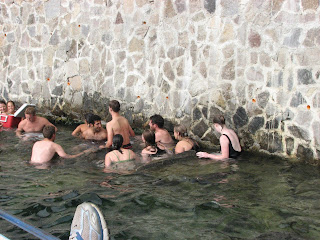
After lunch we hopped back on the boat and made for a nice little hot spring in between our village and the next one over, to hang out and have a few cold drinks (surprisingly difficult to keep your beverage above water when you’re sitting on slippery, algae-covered rocks, and trying to fight off an onslaught of waves).
What came next? Oh yeah…
The cross-dressing party.

Since I don’t see public office anywhere in my near-future, and in the interests of saving face by beating everyone to the punch, I’ll just go ahead and publish this myself. That night (apparently it’s a tradition there) our hostel decided that the best way to celebrate a great day on the lake would be…for all the guys to put on dresses. Fortunately, having won the scavenger hunt, my team (with three guys on it) was rewarded with a few rounds of drinks, making the prospect of slipping my manly figure into a 80’s-era purple evening gown, well…not the worst idea ever? At least they breathe well. Anyways, enjoy.Although it’s hard to top that last act, here’s one more piece of Guatemala fun for your viewing pleasure. I’m not sure if this one’s any more PG, although they don’t seem to mind here, since it’s a public road sign.

Wednesday, October 3, 2007

Coolest Swing Ever

As promised, the coolest swing ever.

Tuesday, October 2, 2007

A Short History of Guatemala

Before beginning this tale, I must call upon a muse to bless my humble quill. Perhaps Ms. Chiquita Banana will offer her services; she would seem an appropriate choice. Ah yes, I can feel her presence already. But I get ahead of myself. Let’s begin.

Guatemala, like just about every other country within an 800 mile radius of Christopher Columbus’s famed but mistaken landing, was birthed into the volatile, unforgiving world of colonialism.

Epidemics were introduced.

Natives were enslaved/conquered/hunted.

Great civilizations were toppled.

So began the Spanish presence here 500 years ago. But let’s fast-forward awhile, I promised this would be a short history.

In 1821 Guatemala shucked off the yolk of Spanish imperialism and gained its “formal” independence, although informally (i.e., realistically) nothing much had changed. The elite social-economic vacancies left in the Spanish wake were quickly filled by the meztizos, shifting the country’s hierarchy, but perpetuating the same colonial conditions (for more on this repetitive trend in Guatemalan history, the kind reader should refer to my upcoming novel: “Zero Sum Game: Guatemala in a Nutshell”) The only real difference being that now the country’s profits, rather than sailing their way across the Atlantic to take their final resting place in the Spanish treasury, instead took residence in the pockets of a few powerful families, eager to repress their partially indigenous ancestry and capitalize on their countries resources. It was through this window that American investors began to sink their teeth, and their trowels, into Guatemalan soil.

From this newly-independent state, Guatemala quickly plummeted into a hundred year stretch of dictatorial rule. The last (and perhaps worst) two dictators during this period, Manuel Cabrera (1898-1930) and Jorge Ubico (1930-1940) managed to surrender, almost entirely, the country’s sizable pool of natural resources to foreign hands. During this brokering, the American-owned conglomerate United Fruit Company, one of the main players in this lovely performance, managed to make off with 40% of the country’s most fertile land! Sound like a good idea? Then, in the interests of making a running for the “most outlandish display of corruption” entry in the Guinness Book of World Records, the very same United Fruit Company was also allowed to gain control of the country’s only port, the majority of its railroads, and all of its electricity production. Let’s see now, that locks up food, energy, and both national and international transportation. After adding to this mess a secret police force and the partial reinstitution of slavery, it seemed our dear Guatemala had hit rock bottom.

Then, in 1944, a miracle happened. Guatemala accomplished the near impossible. In a surge of self-motivated, self-organized, and self-implemented inertia, the dictatorship of Ubico was overthrown and replaced by a sound and stable democracy!! I liken this event to a gust of wind rustling through a deck of cards and leaving them behind in a delicately stacked house. It was known as the October Revolution, and it marked the beginning of an epoch in Guatemala’s history quite appropriately remembered as the “Ten Years of Spring.”

The first president under the new democracy was Juan José Arévalo. He introduced the first reforms in the country’s newly-earned liberalization including the right to unionize and form political parties. He also introduced Guatemala, for the first time, to the concepts of social security and healthcare. After his five-year term (Guatemalan presidents can’t be re-elected) he was succeeded by Jacobo Arbenz, one of the officers who had led the coup to unseat Ubico (and then stepped aside to implement a democracy). Under Arbenz, the country proceeded into a period of unprecedented freedom, modernization, economic growth, and tranquility. One of his most admirable, although ultimately fatal efforts was to regain a hold on the nation’s ample supply of natural resources. Naturally, this meant grappling with the United Fruit Company.

But Arbenz, bless the man, took them head-on. He build a new national port (to compete with the United Fruit’s control of international trade), planned a new highway (to compete with their control of national trade), as well as a hydro-electric plant (to compete with their control of energy). His most daring, revolutionary move, however, came in the way of land redistribution. Recognizing that the country’s most precious resource, its agriculture, had been molded out of the bedrock of colonialism, and that the country could never truly move forward until the playing field had been adjusted, he took (legal) measures to reform the current property distribution. In 1952 the Guatemalan Congress approved his plan, Decree 900. According to Decree 900, the government was given the right to expropriate the unused land of the largest plantations in the country (small and even medium sized plantations could not be touched, nor could large plantations that were being fully used—and Arbenz himself actually subjected his own land to this expropriation). The government paid for all expropriated land at face-value, as determined by declared tax value.

Now here’s where things get interesting. The United Fruit Company (the largest landowner in the country) could currently declare approximately 550,000 acres of land, but only about 15% of that land was actually being used, making it subject to expropriation. However, there was just this one little snag…U-Fruit had been seriously, nay, heinously undervaluing its land for years for tax evasion purposes. Can you guess where this is going? Well, the government kindly handed over the “declared” value and quickly set to redistributing its new property to Guatemalan farming families.

Checkmate right? Ha! Not to fret Fruit lovers, for they still had some very dirty tricks up their sleeve. You see, Fruit was, well, let's just say uniquely well connected in Washington; it had some influential stockholders who did not take kindly to potential economic sacrifices. And so when Arbenz began his little “Guatemala will rise from the ashes” game, jeopardizing the company’s interests, Fruit merely smiled, made a few phone calls, and slammed the American diplomatic and military arsenal down Arbenz’s throat.

And then they pulled the trigger.

Now, who might these stockholders have been? The two most important stockholders to whom I have alluded just so happened to be the Secretary of State, John Foster Dulles, and his brother, the director of the CIA, Allen Dulles. And what they did is worthy of tears.

Here's what went down. The Dulles brothers, using the leverage that their positions afforded, sent in the CIA on a covert operation to lead a coup d’etat and oust Arbenz. Using all manner of propaganda and military force, including aerial bombing and the training of a “Liberation Army” of mercenaries, the CIA turned peace into panic. This, coupled with economic and diplomatic isolation, quickly had Guatemala on its knees. A dejected Arbenz was forced into resignation and exile. And here’s the kicker, our outwardly publicized reason for the invasion: liberating Guatemala from communism. That’s right, in the name of fighting communism the United States went into Guatemala and collapsed the first and only legitimate democracy it’s ever had.

Alas, we must all be reminded that it only takes one more gust to knock the house of cards right back to where it began. And that revenge is a dish best served with a slice of American pie.

As for beloved Guatemala, it was back to the oligarchies.

Back to the ashes.

A new U.S.-supported “president” quickly stepped in, and in the blink of an eye overturned all the constructive and forward-minded reforms Arbenz had instituted. He also quickly redefined the military as a mechanism for repression. Realizing that peaceful opposition had reached its limits, Arbenz’s supporters turned to guerrilla-like insurgency.

For the next thirty-six years (1960-1996) Guatemala found itself in the grips of civil war. It was your typical Latin American conflict, with the guerrillas, horrendously out-numbered, out-trained, and out-armed, fighting for their land, their freedom, and their democracy, while the military fought for the continued exploitation of human and natural resources, financial incentives, racism, and bloodlust. Sadly, the U.S. continued its support of the oppressors, ahem, Guatemalan military. Among our worst contributions was the training of military personnel and future dictators at the U.S. Army-run “School of the Americas.” There the United States gladly shared with our Hispanic brethren its comprehensive and highly-coveted opus-magnum on the finer points of evil, including torture (the inquisitive reader is kindly directed to the use of napalm and death-squads). One particularly ambitious graduate, Efraín Rios Montt, upon landing the dictatorship in 1982, applied his education to the massacre of over 130,000 civilians. Almost all were indigenous. He was able to accomplish this largely due to the support he received the American president at that time, Ronald Reagan, who called him a supporter of democracy and a great man. He is now wanted internationally on charges of genocide (although, at the time of writing, he has managed to slip comfortably into a congressional seat, thereby cleverly avoiding deportation by taking advantage of the Guatemalan loophole that anyone holding public office is exempt from international law and/or being a decent human being). All told, in thirty-six years of fighting, some 200,000 were killed. The army, it is estimated, was responsible for over 95% of the deaths.

In 1996, at long last, Guatemala finally called a ceasefire and signed the famed “Acuerdos de Paz” or peace agreements. Now, over ten years since their conception, Guatemala has managed to maintain at least the façade of stability. But literacy is still painfully low, formal education often non-existent. Crime is staggeringly high, and rarely punished. Corruption is rampant. Children are overworked, malnourished, and hungry. And the government has little intent to change much of anything.

Such is the “peace” that Guatemala has attained, a culturally and historically relative notion under the most generous evaluation. I will leave it to the reader to measure this current state of affairs against their own definitions of peace, and to grapple with the place and efficacy of passive resistance, and that of aggressive action.

Epilogue
Rios Montt. In 2003 he tried to run for president, but was denied on the grounds of being an international crimial and the antichrist. Hearing this news, he took to the radio making a public announcement imploring his supportors to "take to the streets." Well, that's exactly what they did, armed with guns and machettes, and transported in by his political party, "FRG." In response to the violence, the Supreme Court quickly overturned the decision, and allowed him to run. Thank god he didn't win. He had to settle for senator instead. His politcal party, over which he still presides, is stong as ever. His daughter, a staunch supporter and also a member of the Guatemalan Congress, is married to a current U.S. Senator. The Dulles Brothers recieved a similar brand of "punishment" for their deeds. John Foster has an airport named after him (one of the national ones, at that) and Allen, although sadly without an airport, was still allowed to continue on as CIA director. It wasn't until he botched Bay of Pigs that Kennedy forced him to resign that post. As for the “School of the Americas,” in response to well-deserved criticism, the United States simply decided to change the name to the “Western Hemisphere Institute for Security Cooperation” (in the words of an article I found online, they mine as well have just settled on "The Happy Funland School of Hugs"). This tactic, although as slimy as the school itself, has unfortunately proven quite successful, as I am fairly certain that hardly anyone still knows of its existence. The United Fruit Company took a similar approach, branding itself anew in the 1970’s. You may know it better by this second name: Chiquita Brands International.

Which reminds me, I must thank the lovely Ms. Chiquita Banana for gracing this not-so-short-after-all history of Guatemala. She and her fellow fruit mistresses have left a pulpy scar across this land, but perhaps by inspiring young humanitarians to share this tale, Guatemala will become able, once again, to pull itself back into the light. And to begin a new, happier chapter to its biography. One full, as they say here in Guatemala, of salud, dinero, y amor.

Health, wealth, and love.

Saturday, August 4, 2007

Chickenbuses: The Real Deal

In my last post I wrote that I had my first chickenbus experience.

I lied.

My first real chickenbus experience came this weekend with our trip to Antigua, Guatemala. For five and a half hours we sat, three to a seat, with all of our luggage, pinned up against each other by the natives that were exploding out of the aisles. And we were lucky; we had seats. The buses won’t even leave until the standing-room-only space (aisles) has been filled.

The road to Antigua was filled with construction in anticipation of the upcoming elections. Because the highways are actually two lane roads, they would have to block traffic in one direction at a time (blocking traffic consists of laying down a 2x4 filled with nails on one side of the road). Each time we stopped, locals would pour onto the bus offering snacks of various sorts to we hungry travelers. Miraculously, they actually managed to squeeze up and down the aisles when a transaction needed to be made. Of the more interesting commodities for sale, there was fruit soaked in honey (bees a’swarmin), french fries, and educational pamphlets offering to bestow upon the owner such pearls of knowledge as “What are the four oceans and which one is the biggest?” and “Who was Martin Luther King Jr.?” Once our appetite for snacks and third-grade social-studies had been satisfied, a man jumped up on the bus and began reading passages from the bible.

Once clear of these construction zones, we continued on our way at breakneck speed to make up for lost time. It was approximately at this time that our driver began the unnerving but well-accepted practice of passing cars by swerving into oncoming traffic (the perks of mixing machismo culture and two-lane highways). After another half hour or so we were all startled by a deafening “pop” that came from underneath the bus. We had blown out one of the rear tires.
Naturally, we just kept going.

Not to worry though, maintenance stops are quite plentiful along the Guatemalan highways. Such measures are necessary when you use recycled vehicles and quasi-paved roads. As we continued along our way to the nearest pitstop, the blown tire began slapping up against the wheel-base with each rotation, adding a surprisingly bongo-like soundtrack to our journey.

As soon as the tire had been replaced, our driver resumed his neurotic driving practices. Apparently aggravated by the delays brought on by construction and “burning rubber,” he began attempting to make up for lost time. We must have been going at least 85 mph in what should’ve been a 40 zone. He began cutting corners on turns when you couldn’t see if anyone was coming around the other side and passing anyone and anything that got in his way regardless of oncoming traffic (whistling as he worked). It was roughly at this time that I began contemplating force-feeding him a sedative. I also began wondering if that man who had been reciting the bible had included last rites among the chosen prayers. After a few movie-worthy “just in the nick of time” passes I decided it was better to just close my eyes.

Two buses and a pickup truck ride later, we arrived at last in Antigua, a lovely but touristy city near the capital. Might that be the end of our little adventure? Surely not. Wait for it…the next catch is coming. Our hostel, EarthLodge, isn’t actually located in Antigua, but about thirty minutes outside, up in the surrounding mountains. There are two roads up to EarthLodge—naturally, the easy one, the paved one, was closed for construction. The other alternative, Road “Plan B,” goes straight up at about a 45 degree angle. We piled into the pickup, hoping for the best, but deep down I think we knew that we were riding in “the little engine that couldn’t.” We didn’t get far. Faced with no other option, we found another hostel in the city and resigned ourselves to pass the night there. The owners of EarthLodge told us they knew the foreman of the construction project on the “good road” and could get us up the next morning. Nine large pizzas and a bottle of tequila later, we didn’t much mind the change of plan.

The next morning:
We arrived bright-eyed and bushy-tailed, back in our pickup trucks, at the beginning of the construction zone. For a while it looked like they wouldn’t budge. Apparently, “two pickup trucks full of gringos” wasn’t a specific enough description as to whom they should let pass. The foreman told us he would need to speak to “the white guy” with whom he had originally made the arrangements. “The white guy” was Drew, a Canadian expatriate and owner of our elusive hostel. I didn’t actually hear the conversation that ensued once he showed up, but judging by their body-language, I believe it went something like this:

Drew: What the fuck man?
Foreman: Oye! I’ve got lots of trucks. You think I’m just gonna move them all?
Drew: You said you would!
Foreman: I forgot how many there were. Look! So many trucks!
Drew: I’ll buy you a Pepsi. (that part's true)
Foreman: You’re my best friend, you know that? Alright, let’s clear a path!

Saved by the white man. Who would’ve thought?

Well, it turns out EarthLodge was well worth the trouble. Set in the mountains, it overlooks both the city and the several volcanoes that surround it. They have everything you could ask for. Hiking trails, a sauna, enough green space to throw around a frisbee, and the coolest swing on the planet (I can prove that, picture coming soon). And the food was fantastic. They have their own avocado farm right on the grounds, and make fresh Guacamole everyday. From then on the weekend went by pretty fast. And pretty smoothly. We hiked, we frisbeed, we swang. Dare I say, we conquered? But soon it was time to get back to Xela, to our families, and to our (utterly neglected) Spanish. If only I survive the chickenbus ride home....


Wednesday, July 25, 2007

La Muela


One of Xela’s greatest perks is its location up in the highlands, surrounded by mountains. Last Saturday we took the opportunity to hike up into one of the smaller ones, called here La Muela. The trip began with a short bus ride to the trailhead, which just so happened to be my first chickenbus experience. Chickenbuses are, more or less, American school buses, stripped of their golden glow and reborn with a new paint job worthy of “Pimp My Ride.” Here in Guatemala they are the public transportation staple, although they don’t quite live up to their name, as I have yet to actually see any chickens inside. The hike began along a country road with a moderate incline as we wound through the first farms on the fringes of the city. Every few minutes, a pickup truck passed by, its bed filled to capacity with indigenous mountain-dwellers heading into the city for the day’s work. I can only imagine what a sight we must have been, judging by the mixed stares and chuckles we received, a bunch of gringos, slightly winded, climbing for fun up a hill through which even they preferred to drive.

About half-way up, we came across a very strange sight: a housing development. Posted near the entrance were billboards boasting the quality of life to be found within, alongside pictures smiling, extremely white couples standing in front of their new houses (complete with fountains). Only, when we walked passed the entrance, a little further up the path, the fence blocking our view abruptly ended and we could see into the supposed development. It was, decidedly, undeveloped. Nothing more than an empty field; the land hadn’t even been partitioned. No fountains, no smiling couples, not even a model home. And why should there be? Who could afford it? Such are the outcomes of these anthropolically-minded investments, when a third world country tries to become a first world country without stopping at second base. You see it all the time here; people with cell phones but without a clean change of clothes. And even though you hate it, know it to be a lie, a false sign of progress, a shred of you desperately wants to be fooled.

Eventually we came across a signpost marking the beginning of the climb up to the summit. It warned of rocks and steep ledges, and threatened a 200 Quetzales (Guatemalan currency: $1 = 7.5Q) fine to anyone who did not comply with the outlined rules. Although, as the sign was rusted over, it’s difficult to say exactly what those rules were. Typical Guatemalan Catch-22.

At this point the trail got a lot more interesting, half path, half rock-climbing. Scaling our way up to the top, we were granted breathtaking views of the city below, obscured now and then by clouds drifting alongside us. Finally, up above the smog and decay, I could take in the city without the lingering reminders of desolation, of squalor. I could breathe. As we sat on the crags overlooking Xela, we were caught by the sound of singing, of ceremony, coming from just behind the next ledge. We stumbled up to find the source. The first thing I saw was an indigenous family, a mother, father, and two daughters. I smiled, stupidly. Then I saw the coffin, not more than four feet long. I tightened, turned away, and quickly stumbled on ahead with the others to a nearby pinnacle, embarrassed by the intimacy I had unknowingly invaded.

From our new post we could take in the funeral without the guilt of voyeurism. Observing Mayan rituals is a rare privilege; they are an extremely closed society. Still, it wasn’t just the novelty that held us in. Staring down at the city, something about the music just resonated, permeated, drenched us. And we just sat there. Eventually, ten or fifteen minutes later, one of the other students broke the silence. “Do you think belief in an afterlife diminishes one’s value of life?” she asked. I looked over at the family, clearly religious one way or another, now sobbing as they sang. “Doesn’t seem to,” I replied. “What about suicide bombing?” she said. Walked right into that one. Psychology vs. Natural Selection 101. It goes both ways I guess. As I contemplated the reality of father’s sending their sons to do “God’s work” with dynamite strapped to their chest, I flashed back to a similar thought I’d had the other day walking through the market: what about poverty? Did that diminish one’s value of life? No where else in the city does the poverty feel more real than in the market, watching seven year old boys shine shoes, covered in polish and god knows what else, so their families can earn the extra dollar a day they need to survive. It’s harsh, utterly unforgiving, the reality of that poverty. Still, that very reality somehow makes life without poverty equally real. The fact that that life exists somehow reinforces the notion that it doesn’t have to.

My vision of the market dissipated and I was back to the mountains, the funeral. El fuego está cayendo, el fuego está cayendo (the fire is falling, the fire is falling), sang the mother. Whether this was an apocalyptic theme of some Christian-Mayan fusion, or simply the folk music product of hundreds of years spent nestled in the cradle of active volcanoes, I’ll never know. But it seems to put into words a lot of my sentiments about life here. English has a very nice translation. The shit has hit the fan.

Yet somehow, up in the mountains, breathing the pristine air and watching the clouds float by, obscuring the city and all of its problems, I felt anchored, at ease. Perhaps it’s fitting then that La Muela, a prominent sight southeast of the city, is the landmark I rely on to guide myself home each night.


Wednesday, July 18, 2007

Mi Familia

Let me introduce my family. I’m living just around the corner from our language school, in Zone 1 of the city, with the wonderful Maldonado family. There are three full-time residents, Floridalma, the mother of the house, and her two grown daughters, Lucy and Rosana. Floridalma works days in a salon just down the street. She’s also a wonderful cook, and seems to be enjoying my large appetite. Lucy is twenty, and in college here in Xela studying restaurant and hotel management. She's also the greatest salsa dancer in the entire world. Rosana is in her mid thirties, and works as a psychologist with an NGO outside the city. Floridalma's mother also lives with us, for the most part. She's a very sweet old lady but I cannot understand a word that comes out of her mouth. It might not be me though, because there a several signs of senility. Most notable is that fact that she can't seem to remember my name. Each morning she cycles through a few and eventually settles on one for the day. Yesterday I was Hakim. There’s also plenty of extended family to go around, dropping in from time to time. I’m still working on names, but I think I recognize most of the faces now. They’ve all been very welcoming and friendly and I feel extremely lucky with my placement. I really couldn’t have asked for a better atmosphere to get to know life here.

I should probably add, for those curious, that my family falls in the upper-middle class here (Yes, they actually have a middle class in Xela!). Their house is extremely spacious and in excellent repair by Guatemalan standards. They have a kitchen, dining room, living room (with a TV) and four bedrooms. They also have two mid-range cars, which is very unusual. But they are also university educated, a privilege granted to only 1% of the population here, which speaks volumes about their status, and their means.